Last updated 2026-07-26
TL;DR
A restaurant most commonly loses its liquor license for selling to minors or visibly intoxicated patrons, missing renewal deadlines, unpaid state or local taxes, ownership changes not reported to the ABC board, or repeated violations found during compliance checks. Most states suspend before they revoke, but a pattern of violations, a felony conviction, or an expired renewal can end a license outright.
why would a restaurant lose their liquor license
Most license losses come down to five categories: selling to minors or obviously intoxicated people, missing a renewal deadline, falling behind on state or local taxes, failing to report an ownership or management change, or racking up repeat violations that trip a compliance threshold. None of these happen overnight in most states. Regulators tend to warn, fine, then suspend before they revoke, but every state's ABC agency runs its own point system or violation ladder, and some infractions (serving a minor who then causes a fatality, for instance) can skip straight to revocation. The Alcohol and Tobacco Tax and Trade Bureau (TTB) handles the federal side, mainly the Basic Permit required under the Federal Alcohol Administration Act for anyone who produces or imports alcohol, but retail liquor licensing is a state and local matter [1]. That means the actual rules on what gets you suspended versus revoked live in your state's ABC statute, not federal law. A bar in Texas and a bar in New York can lose their license for the same conduct but face completely different processes and timelines. If you're mid-buildout with a lease signed and an opening date on the calendar, the license risks that matter most right now are different: missing a renewal window during a slow first year, or inheriting a compliance problem from a prior owner during a license transfer. Both are avoidable with a calendar and a checklist, which is most of what this article is.
can you serve alcohol without a liquor license
No. Selling or serving alcohol without a valid, current license is illegal in every state and is treated as a criminal offense in most jurisdictions, more than a civil infraction. Even a single documented sale without an active license can trigger fines, forced closure, and in some states a bar to reapplying for a set period. This matters more than people think during the gap between a lease start and a license approval. Plenty of new owners want to do a soft open, comp drinks for friends, or run a private event before the license clears, assuming 'nobody's paying for it' makes it legal. It doesn't. Most state statutes define 'sale' broadly enough to include drinks included in a cover charge or bundled into an event package, and giving away alcohol at a for-profit business without a license is still typically prohibited under state ABC codes, though the exact language varies by state, so confirm with your state ABC authority before doing any pre-license pour. Some states allow a temporary or special event permit while a full on-premise license is pending. California, for example, offers temporary licenses for specific short-term situations through the Department of Alcoholic Beverage Control [2]. If your opening date might land before final approval, ask your state ABC authority about a temporary or interim permit rather than gambling on a quiet soft open.
how much is a liquor license
There's no single national number. License costs range from a few hundred dollars for a beer-and-wine permit in a rural county to six figures for a full liquor license in a quota-restricted city, and the spread exists because states use two very different systems: direct-issue licenses with a set state fee, and quota-based licenses where a fixed number exist and you buy one on the open market from an existing holder. In quota states, the fee you pay the state might be modest, but the market price for the license itself (what you pay a broker or seller for one of the limited number available) is the real cost, and that number moves with local supply and demand. New Jersey is the clearest example: municipalities are capped at one plenary retail consumption license per roughly 3,000 residents under state law, and in built-out towns with no licenses available, buying one from an existing holder can run into six figures [3]. In open-issue states, you're paying a state-set application and license fee, which your state ABC authority publishes on its fee schedule, plus local fees from your city or county. Always confirm the current fee with your state ABC authority rather than trusting a number you saw online, because these fees change and vary by license class, by city, and sometimes by your projected annual alcohol sales.
how much is a liquor license in florida (and how much is a liquor licence in florida)
Florida issues several license types through the Division of Alcoholic Beverages and Tobacco, and the two most relevant to restaurants are the SRX license (for establishments that derive at least 51% of gross revenue from food, with no quota restriction) and the quota-based series 4-COP license, which is capped by county population and often traded on a resale market [4]. The SRX route has a state-set application and license fee published by the Florida DBPR, and because it isn't quota-restricted, you're paying the state fee plus your local costs, not a market premium. The quota 4-COP license is the opposite story: because Florida caps the number of quota licenses per county based on population under state law, in built-out counties you're often buying a license from an existing holder, and that price is set by whatever the market will bear, not by any state fee schedule [4]. Because fee schedules and quota counts change and differ by county, don't rely on any number you find in an article, including this one. Pull the current fee schedule directly from the Florida DBPR's ABT licensing page and confirm the quota status of your county before you commit to a lease or make an offer on an existing license.
how to get a liquor license (and how to obtain a liquor license or liquor licence)
The process is broadly the same across states, even though every state runs its own forms and timeline. Here's the general sequence: 1. Confirm your license type. Restaurants typically need an on-premise consumption license, which is different from a package store or off-premise license. Some states split this further by percentage of food sales, like Florida's SRX category [4]. 2. Check quota status. Find out whether your state, county, or city caps the number of licenses available. If it's quota-restricted, you may need to buy an existing license rather than apply for a new one. 3. Gather your business documents. Most states want your lease, entity formation paperwork, EIN, floor plan, local zoning approval or a certificate of occupancy, and background information on every owner with a qualifying ownership stake. 4. Apply with your state ABC authority. Some states also require a separate local approval (city council vote, local ABC board hearing, or public notice period) before or alongside the state application. 5. Pass inspections. Fire, health, and zoning sign-off is typically required before the license is issued, more than before you open. 6. Get your staff trained. Many states require responsible beverage service (RBS) training for anyone pouring or selling alcohol, either as a licensing condition or a legal requirement independent of the license itself. Timelines vary widely, from a few weeks in low-regulation states to several months in cities with public hearing requirements or a quota waitlist. Build your opening date backward from the slowest step in your specific state, not the fastest one you heard about from a friend in another state.
how can i get a liquor license if my county has no available quota
If your county or city has hit its quota cap, you generally have three options: buy an existing license from a current holder (the resale market), apply for a different license type not subject to the quota, or wait for a new license to become available when the population threshold rises or an existing license lapses. Buying an existing license means you're doing a license transfer, not a new application, and the process is different: you'll typically file a transfer application with your state ABC authority, the current holder needs to be in good standing (no unresolved violations or unpaid taxes), and many states run a public notice or objection period before approving the transfer. This is also where inherited problems show up. If the license you're buying has an outstanding violation or a tax lien attached, that can follow the license into your hands, so a license history check with the state ABC authority before you sign anything is worth the delay. Some states carve out exceptions to quota for specific business types, like small breweries, wineries, or restaurants below a certain seating capacity. Ask your state ABC authority directly whether any exception applies to your concept before assuming you need to buy into the resale market.
how to get a bartending license (or bartending certificate)
Most states don't require a standalone 'bartending license' the way they require a business liquor license, but they do often require individual servers and bartenders to complete a responsible beverage service (RBS) or alcohol server training course, sometimes as a condition of the establishment's license and sometimes as an independent state mandate. These courses (often called TIPS, ServSafe Alcohol, or a state-specific equivalent) typically cover checking ID, recognizing signs of intoxication, and understanding liability under your state's dram shop law. Completion usually produces a certificate, not a license, and it's usually tied to the individual server, not the business, meaning it travels with the bartender from job to job within that state. Requirements vary by state and sometimes by county. Some states mandate training for every alcohol seller and server, some only require it for the person who holds the manager designation on the license, and some leave it fully optional. Check your state ABC authority's training requirements page directly rather than assuming a national standard applies, because there isn't one.
can anyone take the bar exam
This one's unrelated to liquor licensing, it's about becoming a lawyer, but it shows up often enough in search that it's worth a clean answer. No, not anyone can take the bar exam. Eligibility generally requires graduating from an ABA-approved law school (or meeting an alternative pathway some states allow, like California's law office study program) and passing a character and fitness review conducted by the state bar [5]. If you're researching this because you're dealing with a legal dispute over your liquor license, like a denial, suspension, or contested transfer, you'll want an actual attorney, not a search result. You can look up licensed attorneys through your state bar's public directory, and in Florida specifically, the Florida Bar member search tool lets you verify a lawyer's license status before you hire them. This isn't legal advice, just a pointer to the right verification tool.
what actually gets a liquor license suspended or revoked
State ABC boards generally use a tiered system: warnings and fines for minor first offenses, suspension for repeat or serious violations, and revocation for the most severe cases or a pattern of unresolved problems. The specific violations that show up most often across state enforcement actions include: - Selling to a minor, confirmed through a compliance check or sting operation
- Serving a visibly intoxicated patron, especially where it leads to a dram shop lawsuit after an incident
- Allowing illegal activity on premises (drug sales, prostitution, unlicensed gambling)
- Operating outside licensed hours or in an unlicensed area of the premises
- Failing to pay state alcohol excise taxes or sales taxes
- Missing the license renewal deadline and lapsing into unlicensed operation
- Undisclosed change of ownership or a disqualifying background issue in a new owner
- Diversion or tied-house violations (illegal financial arrangements with a distributor or manufacturer) Many states publish their violation and penalty schedule publicly. Pennsylvania's Liquor Code, for example, sets out the statutory grounds and process for suspending or revoking a license, and enforcement actions are a matter of public record [6]. Checking your own state's published enforcement history is a fast way to see what actually gets bars in trouble locally, more than in theory. A single violation rarely ends in revocation on its own unless it's severe (serving a minor who then dies in a drunk driving accident, for example, has led to revocation and criminal charges in multiple states). It's usually the second or third violation, or a violation stacked on top of an unresolved tax or renewal problem, that tips a board from 'fine and warning' to 'suspend or revoke.'
how does a license renewal lapse turn into a license loss
Renewal deadlines are the single most avoidable way restaurants lose a license, and it happens more than owners expect, especially in the first year when everyone's attention is on the kitchen and the dining room, not the compliance calendar. Most states require annual or biennial renewal with a specific filing window, and missing it doesn't just mean a late fee, in many states it means your license lapses and you're legally unlicensed until you reinstate or reapply. In quota states, a lapsed license can be worse than a fine, because if the license reverts to the state or municipality, you may lose your spot entirely and have to reapply through the same quota-constrained process a brand-new applicant faces, even though you'd held the license for years. This is exactly the kind of risk a lease-signed, opening-date-set owner needs on a calendar from day one, not something to discover from a certified letter. Set a recurring reminder at least 90 days before your renewal date, and confirm your specific state's renewal window and grace period (if any) with your state ABC authority, because grace periods range from generous to nonexistent depending on the state.
what happens during a compliance check or inspection
State ABC agencies and local police departments regularly run compliance checks, most commonly minor decoy operations where an underage person (working with law enforcement) attempts to buy alcohol to test whether staff check ID correctly. These checks happen with no advance notice, and a failed check typically generates a citation on the spot, with the establishment learning about the violation formally afterward. Beyond decoy operations, ABC investigators and local licensing boards can also inspect for licensed capacity compliance, proper posting of the license itself, whether service is happening outside the licensed footprint (like an unapproved patio), and whether the business is operating under the name and ownership structure on file with the state. The practical takeaway for a new operator: train every server and bartender on ID-checking procedure before opening day, not after the first citation, and keep your posted license, your floor plan, and your ownership records matching exactly what's on file with the state. Mismatches here are a common and completely preventable source of violations.
what should a new owner actually do to protect the license
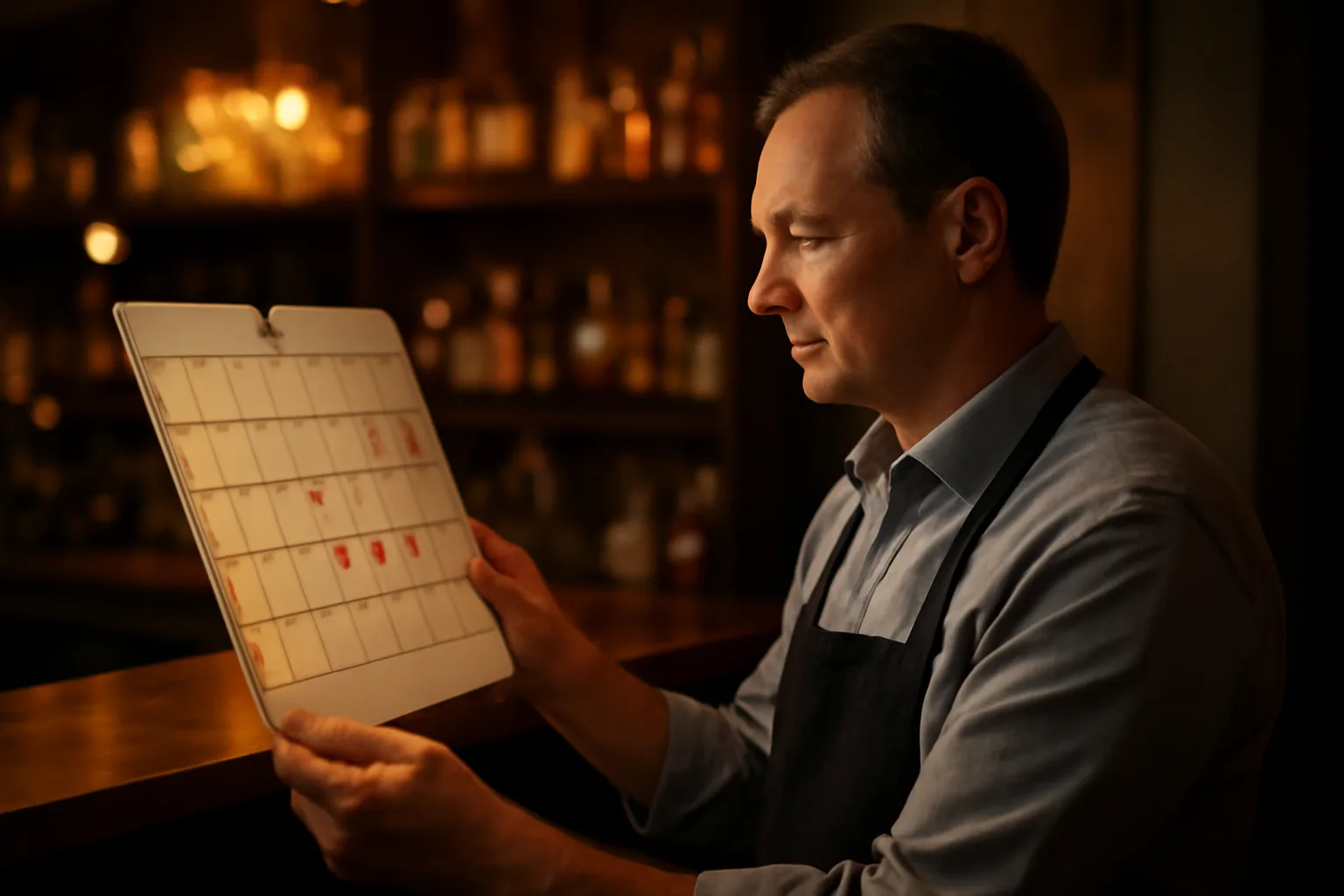
Build a compliance calendar the same week you sign your lease, not the week before your first renewal is due. Put renewal dates, RBS training expiration dates for staff, and any local permit renewal (health, fire, occupancy) on one shared calendar with alerts at 90, 60, and 30 days out. Train every server on ID checks and visible intoxication cues before opening day, and document that training. If a compliance check happens in month two and your staff wasn't trained yet, that's a much harder position to be in than having a signed training log to show an investigator. If you're buying an existing license through a transfer rather than applying fresh, get the license's violation history and tax status from your state ABC authority in writing before you close, not after. A license with an unresolved compliance flag can become your problem the day the transfer is approved. If you want a structured way to plan out every deadline and document from lease signing to opening day across your specific state's requirements, LiquorReady's $199 one-time License Roadmap Builder builds a back-planned timeline from your target opening date, though it isn't a substitute for confirming specifics directly with your state ABC authority or consulting an attorney for anything contested.
where to double check your state's specific rules
Every fact in this article about fees, quotas, and specific violation categories varies by state, and most of them change periodically as legislatures amend ABC codes. The two sources worth bookmarking are the TTB's federal permit information (for the federal Basic Permit side of the business, which applies mainly to producers and importers, not most restaurants) [1], and your own state's ABC or liquor control agency site, where the actual license fee schedule, renewal deadlines, and violation penalty structure live. If you're comparing notes across states, browsing a state guide for the specific license types and market conditions in your state is a faster starting point than generic national averages, which tend to flatten out exactly the differences that matter for your budget and timeline.
Frequently asked questions
How much is a liquor license?
It depends entirely on your state and whether licenses are quota-restricted. Open-issue states charge a set state fee, often a few hundred to a few thousand dollars, published by the state ABC authority. Quota states can run into six figures because you're buying an existing license on the resale market, not paying a flat state fee. Always confirm current numbers with your state ABC authority.
How do I get a liquor license?
Confirm your license type and whether your area is quota-restricted, gather your lease, entity documents, floor plan, and owner background information, then apply through your state ABC authority, often alongside a local approval step like a city council vote. Pass required fire, health, and zoning inspections before the license is issued. Timelines range from a few weeks to several months.
How do I obtain a liquor license if I'm buying an existing restaurant?
You'll typically file a license transfer application rather than a new application, and the existing license needs to be in good standing with no unresolved violations or unpaid taxes. Get the license's compliance and tax history from your state ABC authority in writing before closing, since inherited problems can attach to you once the transfer is approved.
How much is a liquor license in Florida?
Florida's non-quota SRX license (for restaurants earning at least 51% of revenue from food) has a state-set fee published by the Florida DBPR. The quota-based 4-COP license is capped by county population, and in built-out counties it's often purchased on the resale market at a price set by demand, not a fixed fee. Confirm current numbers with Florida DBPR.
Can you serve alcohol without a liquor license?
No. Selling alcohol without a valid license is illegal everywhere and typically carries criminal penalties, more than fines. This includes 'free' drinks bundled into a cover charge or event package at a for-profit business. If your license is still pending near your opening date, ask your state ABC authority about a temporary or interim permit instead.
How to get a bartending license?
Most states don't issue a standalone bartending license, but many require servers and bartenders to complete a responsible beverage service (RBS) course covering ID checks and intoxication signs. This produces a certificate tied to the individual, not the business, and requirements vary by state, so check your state ABC authority's training rules directly.
Can anyone take the bar exam?
No. Bar exam eligibility generally requires graduating from an ABA-approved law school or completing an accepted alternative pathway, plus passing a character and fitness review through the state bar. This is unrelated to alcohol licensing, it concerns becoming a licensed attorney, verifiable through your state bar's directory.
What's the fastest way for a restaurant to lose its liquor license?
Selling to a minor during a compliance check combined with a prior unresolved violation is one of the fastest paths to suspension or revocation in most states. A close second is letting the renewal deadline lapse, since in many states that immediately makes continued alcohol sales unlicensed and illegal until reinstatement or reapproval.
Does a felony conviction affect an existing liquor license?
In many states, a disqualifying criminal conviction for an owner or a listed manager can trigger license review or revocation, particularly for offenses related to alcohol, drugs, or fraud. Rules on which convictions disqualify and whether they apply retroactively to an existing licensee vary significantly by state, so confirm specifics with your state ABC authority.
Can a liquor license be revoked for unpaid taxes?
Yes. Unpaid state alcohol excise taxes or general state sales taxes are a common trigger for suspension in many states, since ABC agencies and state revenue departments often share enforcement data. Some states will not renew a license at all if there's an outstanding tax balance on file.
What happens if I miss my liquor license renewal date?
In most states, missing the renewal window means your license lapses and continued alcohol sales become illegal until you reinstate or reapply. In quota-restricted areas, a lapsed license can also cost you your spot in the quota entirely. Set reminders at 90, 60, and 30 days out, and confirm your state's specific grace period, if any.
Do I need a lawyer to fight a liquor license suspension?
It's not legally required in most states, but contested suspensions or revocations often involve a formal hearing process with rules of evidence, and an attorney experienced in ABC administrative law can materially change the outcome. You can verify a licensed attorney through your state bar's public directory before hiring.
Sources
- Alcohol and Tobacco Tax and Trade Bureau, 27 CFR Part 1 (Basic Permit Requirements Under the Federal Alcohol Administration Act): Federal alcohol permitting under the Federal Alcohol Administration Act applies mainly to producers and importers, not most retail restaurants
- California Business and Professions Code Section 24045.1 (Temporary Retail License): California offers temporary license options for certain short-term or pending situations
- New Jersey Revised Statutes Section 33:1-12.14 (Limitation on Number of Plenary Retail Consumption Licenses): New Jersey caps plenary retail consumption licenses at roughly one per 3,000 municipal residents
- Florida Statutes Section 561.20 (Limitation Upon Number of Licenses Issued): Florida's SRX license is non-quota for restaurants deriving at least 51% of revenue from food, while the 4-COP license is quota-restricted by county population
- California State Bar, Admissions Requirements: Bar exam eligibility requires graduation from an approved law school or an accepted alternative pathway plus a character and fitness review
- Pennsylvania Liquor Code, 47 P.S. Section 4-471 (Suspension or Revocation of Licenses): Pennsylvania's Liquor Code sets out statutory grounds and process for suspending or revoking a license