Last updated 2026-07-26
TL;DR
There's no single "mobile bar license" in California. Most mobile/catering bar operators need a Type 58 Caterer's Permit added to an existing ABC license, or they work under a licensed caterer's authorization for each event. Costs and processing depend on the base license, event permits, and local health/fire sign-off, so confirm current fees with California ABC before you book events.
What license do you actually need to run a mobile bar in California?
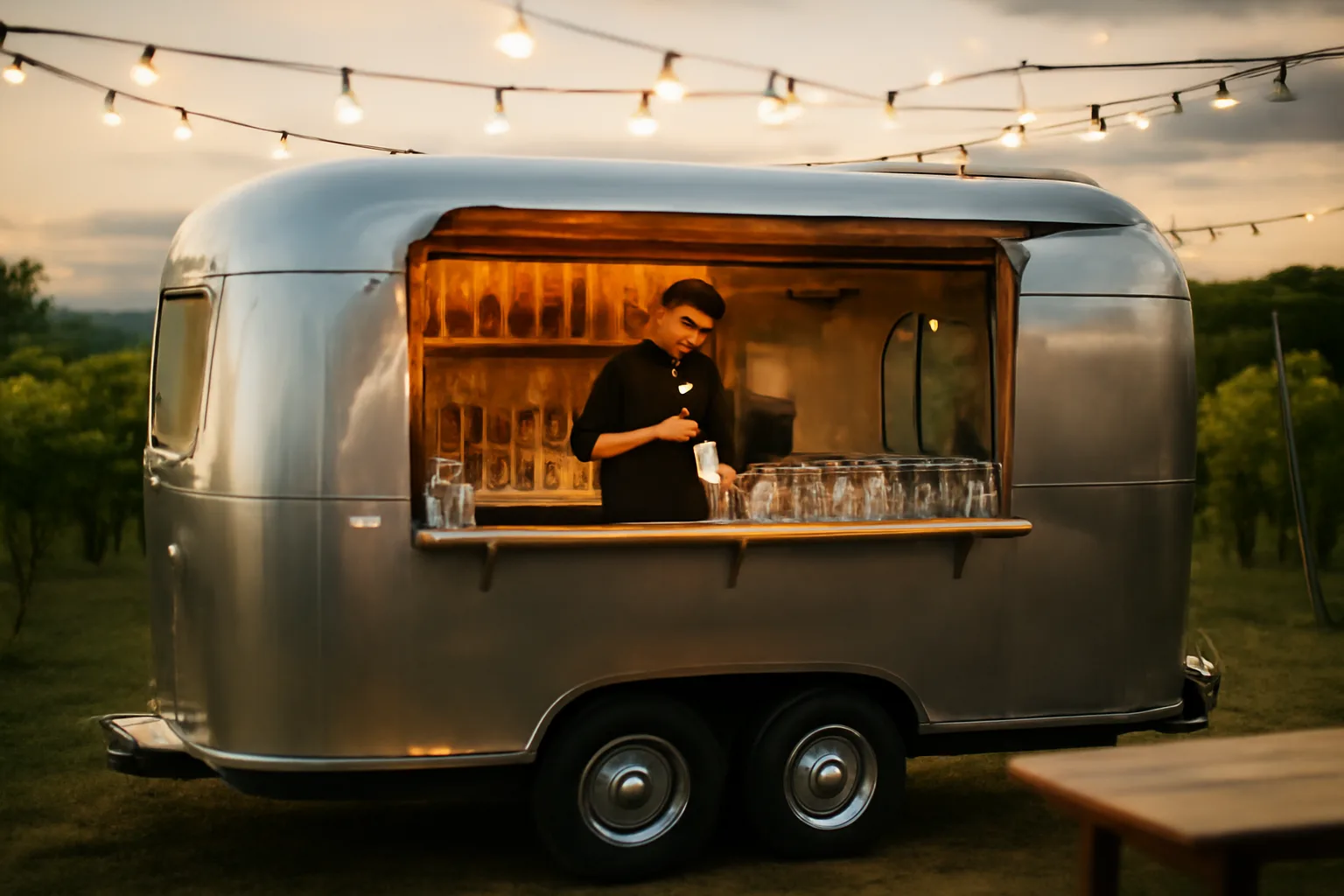
California doesn't issue a standalone "mobile bar license." Instead, the Department of Alcoholic Beverage Control (ABC) lets an existing licensee add a Type 58 Caterer's Permit, which authorizes serving beer, wine, and spirits at an off-site event the licensee is catering. You need to already hold (or be applying for) an underlying retail license, most commonly a Type 47 (on-sale general, bona fide public eating place) or Type 48 (on-sale general, public premises), before ABC will attach a Type 58 to it. Check the ABC's own license type list to confirm the current type numbers and definitions, since ABC periodically clarifies eligibility criteria [1]. If you're building a mobile bar business from scratch (a trailer, a vintage truck conversion, a portable tap wall), the practical path is: get licensed at a fixed base of operations (a commissary kitchen, a bar you own, or a catering company's licensed premises), then layer the Type 58 Caterer's Permit on top so you can pour at private events, weddings, and corporate parties. Some operators instead partner with an already-licensed caterer or restaurant and staff the event under that entity's permit, which avoids holding a license at all but means you don't control the license. A separate, narrower option exists for one-off nonprofit or civic events: the Type 75 Retailer of Original Package special license and various daily event permits ABC issues for single occasions. These are not a substitute for an ongoing mobile bar business but matter if you're doing occasional gigs rather than running catering as your core model. Bar has more on how the state-by-state on-premise categories generally work if you're comparing California's approach to other states.
How much does a liquor license cost in California?
Cost has two very different components: the state application/annual fee, and, for the most common on-sale general licenses, the market price you pay a private seller because the license is capped by a population quota. California caps the number of on-sale general licenses (Type 47 and Type 48) issued per county based on population, under Business and Professions Code Section 23817 [2]. Once a county hits its quota, new licenses only become available through the ABC's public drawing for newly authorized licenses, or by buying an existing license from another licensee on the open market, transfer included. In dense coastal counties those resale prices can run into the tens of thousands to low six figures, and they move with local supply and demand, so don't treat any number you see online as current; ask a California ABC district office or a licensed consultant for what's trading in your specific county right now. On top of that, ABC charges its own original and annual license fees, which vary by license type and are published on the ABC fee schedule [1]. The Type 58 Caterer's Permit itself carries its own filing fee, separate from your base license's fee. Because these numbers change and differ by license type, confirm the current figures directly on the ABC fee page before you budget, rather than relying on a fixed number from any article, including this one.
How does the Type 58 caterer's permit actually work?
The Type 58 is an endorsement, not a freestanding license. It attaches to an existing on-sale license (typically Type 47 or Type 48) and lets that licensee sell and serve alcohol at a specific off-site event location for a specific date or date range, as long as ABC has been notified in advance per its catering notification requirements [1]. In practice this means you file a notification (not a full new application) for each event, listing the event address, date, and hours. ABC's guidance describes the caterer's permit as authorizing sales "in conjunction with a function, party or event held at other than the licensed premises" [1], which is the exact language that matters if a local police department or ABC investigator questions your paperwork at an event. Because the underlying license is what carries the real weight (the quota, the transfer value, the annual renewal), most of your due diligence effort should go into securing that base license correctly, not the caterer's add-on. If you're expanding an existing restaurant or bar into event catering, California bar covers how the state's on-sale categories fit together, which is useful context before you file the Type 58 paperwork.
How do I get a liquor license in California, step by step?
The mechanics are the same whether you're opening a bar, a restaurant, or a mobile catering operation that needs a base license first. 1. Confirm which license type fits your model (Type 47 for a restaurant that also wants full bar service, Type 48 for a bar/nightclub with minors excluded, Type 41 for beer and wine only) using ABC's license type descriptions [1]. 2. Check county quota availability under Section 23817 if you're pursuing a Type 47 or 48 [2]. If the county is at capacity, you'll be buying an existing license from a seller (a transfer) rather than getting a new original issuance. 3. File the ABC application, which includes fingerprinting, a background check, premises diagrams, and public notice (a posted notice at the premises and often a published notice in a local paper) so the public and local law enforcement can protest if they object. 4. Get local sign-off. Most cities require a separate conditional use permit or zoning clearance for on-sale alcohol, plus health department and fire marshal approval, all independent of the ABC process. 5. Once ABC issues the license, file for the Type 58 caterer's endorsement if you plan to serve off-site. Processing timelines vary a lot by county workload and whether protests are filed. ABC doesn't publish a single guaranteed turnaround. Build slack into your opening date rather than assuming a fixed number of weeks.
How much is a liquor license in Florida, for comparison?
Florida runs a very different system, which matters if you're comparing states or planning a multi-state mobile bar business. Florida's quota licenses (the "4COP" full liquor license series) are capped by county population under Florida Statutes Section 561.20 [3], similar in concept to California's cap but with different math and a different secondary market. Because Florida quota licenses are also transferred on a private resale market once a county is capped out, the price you'd pay depends entirely on which county and how tight that county's quota is, the same dynamic as California. Some counties have looser caps or use special redevelopment-area exceptions that create additional license availability outside the base quota formula [3]. There is no single statewide number for "how much is a liquor license in Florida," and any article that gives you one flat figure is guessing. Check Florida bar for how that state's license categories and quota system work in more detail, and confirm current market pricing with a Florida ABT district office or a local broker before you budget.
Do I need a bartending license to work behind a mobile bar in California?
California does not require bartenders to hold a state bartending license or certificate to pour alcohol. What California does require, per Business and Professions Code Section 25658 and related ABC responsible-service rules, is that servers not sell to minors or obviously intoxicated patrons, and many counties and cities layer their own training mandates on top. Separately, California's Responsible Beverage Service (RBS) training law (AB 1221, effective July 2022) requires most on-premise servers and their managers to complete ABC-approved RBS training and pass a state exam within specific timeframes of hire, with certification good for a set number of years before renewal [4]. This applies whether you're staffing a fixed bar or a mobile catering rig, since the requirement attaches to the person serving, not the location. Bartending school certificates you see advertised (two-week courses promising job placement) are a private industry product, not a state license requirement, and completing one doesn't substitute for the state's mandatory RBS certification if your county has adopted it. If you're hiring staff for event work, build RBS certification into onboarding before the first event, not after, since ABC can cite the licensee (more than the individual server) for non-compliant staff.
Can anyone take the bar exam? (and why people confuse this with liquor licensing)
This question shows up in liquor-license searches because "bar exam" and "bar license" get conflated in search behavior, but they're unrelated. The bar exam is the test lawyers take to practice law, administered state by state (in California, by the State Bar of California), and eligibility generally requires completing law school coursework or an approved apprenticeship path, not anything related to serving alcohol. If you landed here looking for that exam, you want your state bar association's admissions page, not an alcohol regulator. If you're actually asking whether anyone can serve alcohol at a bar without training, the answer is covered above: California requires RBS certification for most servers under AB 1221 [4], and other states have their own responsible-service training mandates, often called TIPS, TAM, or similar, that you should confirm with your state ABC authority.
Can you serve alcohol without a liquor license in California?
No, not for a commercial mobile bar business. Selling or serving alcohol to the public without an ABC license is a violation of the Alcoholic Beverage Control Act and can trigger criminal penalties and civil fines under California Business and Professions Code provisions governing unlicensed sales [1]. A private, unpaid party where a host pours drinks for guests isn't the same as a business charging for service, staffing, or a package that includes alcohol; the moment money changes hands for alcohol service (even bundled into an "event package" price), you're in licensed-activity territory. There's a narrow gray area some mobile bar operators try to use: charging only a "bartending labor fee" while the client supplies and legally owns the alcohol (a bring-your-own-booze event where you just pour). Some counties tolerate this if the client, not the bartending company, purchases the alcohol and it's genuinely a private event with no public sales. This isn't a loophole you should build a business model around without checking with your local ABC district office first, since interpretation varies and enforcement has gotten more attention as mobile bar and trailer bar businesses have grown.
How do I plan a mobile bar license timeline around my opening date?
Work backward from your first booked event or grand opening the same way you'd plan a fixed restaurant launch. If you're starting from zero (no existing license), budget for: choosing your base license type, securing your fixed commissary or premises address, filing the ABC application with fingerprinting and public notice, clearing any protest period, getting local health and fire approval, and then filing the Type 58 caterer's endorsement. Each of those steps has its own agency, its own paperwork, and its own unpredictable wait time, and they don't all run in parallel cleanly, since ABC often wants local zoning clearance before it finalizes, while your city may want proof of the ABC filing before it issues a conditional use permit. That circular dependency is the single biggest reason mobile bar launches slip past their target date. Build in a buffer of at least a few months beyond whatever timeline you're hoping for, and confirm current processing expectations directly with your California ABC district office, since they don't publish a guaranteed number of weeks. If you want a structured way to map every step against your specific opening date instead of guessing at the order, that's exactly what our $199 State Liquor License Roadmap is built for: a one-time tool that back-plans your state's license, permit, and local approval sequence from your target open date.
What other permits does a mobile bar need besides the ABC license?
The ABC license (plus Type 58 if you're catering off-site) covers the alcohol side, but a mobile bar trailer or truck also needs the same overlapping local approvals any mobile food or beverage vehicle needs. Expect to deal with your county health department for a mobile food facility permit if you're serving any consumables alongside drinks, your local fire marshal if you're running propane or generator equipment, a business license from your city or county, and possibly a separate mobile vending permit depending on the municipality. Some cities also require event-specific temporary use permits for the venues you're booked at, separate from anything ABC issues. None of these substitute for the ABC license or the Type 58 endorsement, they run alongside it, and missing one can shut down an event even if your alcohol paperwork is perfect. Check with your city clerk's office and county environmental health department early, since these local requirements vary block to block in ways state-level research won't surface.
How do license quotas and county caps affect mobile bar operators?
If your mobile bar business is built around holding your own Type 47 or 48 base license (rather than working under someone else's), the county quota under Business and Professions Code Section 23817 directly affects your cost and timeline [2]. In a capped county, you're not applying for a brand-new license from ABC, you're buying an existing one from a current holder, which means price and availability depend on that private market, not a published state fee. Some operators sidestep this entirely by getting licensed in a county with quota room, or by structuring around a Type 41 (beer and wine only) base license, which has different (often less restrictive) issuance rules than the full liquor Type 47/48 category, or by partnering with an existing licensee instead of holding the license themselves. Which path makes sense depends on your event mix (are you mostly doing weddings that want full bar service, or corporate events where beer and wine covers it), and that's a business decision worth working through before you commit to a location or start signing venue contracts.
Frequently asked questions
How much is a liquor license in California?
It depends entirely on license type and county. ABC's own filing fees are published on its fee schedule [1], but in counties where on-sale general licenses (Type 47/48) are capped under Section 23817 [2], you're typically buying an existing license on the resale market, where prices vary widely by county and shift with demand. Confirm current ABC fees and local market pricing before budgeting.
How do I get a liquor license in California for a mobile bar?
You first need a base retail license, usually Type 47 or Type 48, tied to a fixed premises or commissary. Once ABC issues that, you file for a Type 58 Caterer's Permit, which lets you serve at off-site events. There's no separate "mobile bar" license category; the caterer's permit is the mechanism ABC actually uses [1].
How to get a bartending license in California?
California doesn't issue a bartending license. What most on-premise servers need instead is Responsible Beverage Service (RBS) certification under AB 1221, which requires ABC-approved training and a passing exam score within a set window of being hired [4]. Private bartending school certificates are optional and don't replace this state requirement where it applies.
Can you serve alcohol without a liquor license in California?
Not for a paid commercial operation. Selling alcohol service without an ABC license violates the Alcoholic Beverage Control Act and can carry criminal and civil penalties [1]. A narrow gray area exists for private BYOB events where the client owns the alcohol and you're only charging a labor fee, but confirm that interpretation with your local ABC office before relying on it.
How much is a liquor license in Florida?
There's no flat statewide price. Florida's quota (4COP) liquor licenses are capped by county population under Florida Statutes Section 561.20 [3], and once a county's cap is reached, licenses trade on a private resale market where price depends on local scarcity. Some counties also have redevelopment-area exceptions that add license availability outside the base formula.
How can I get a liquor license if my county is already at quota?
You buy an existing license from a current holder through a license transfer, rather than getting a new original issuance from the state. This applies in both California (Section 23817 counties) [2] and Florida (Section 561.20 counties) [3]. Expect to negotiate price directly with the seller and still complete the full transfer application with the state ABC authority.
Can anyone take the bar exam?
This refers to the legal profession's bar exam, unrelated to alcohol licensing. Eligibility is set by each state's bar admissions authority (in California, the State Bar of California) and generally requires completing an approved law school program or apprenticeship path. It has nothing to do with serving alcohol or holding a liquor license.
How do I obtain a liquor license for a wedding or one-off event?
For a single event, you typically don't need your own ongoing license. You either book a caterer or bartending company that already holds a Type 58 (or equivalent) caterer's endorsement, or in some states you apply for a one-day/special event permit directly through the state ABC authority. Requirements and permit names vary by state, so check with your local ABC office.
What's the difference between a Type 47 and Type 48 license in California?
A Type 47 is an on-sale general license for a bona fide public eating place, meaning food service is central to the operation. A Type 48 is an on-sale general license for a public premises like a bar or nightclub, where minors generally aren't allowed on the premises. Both fall under the same county population quota system [2].
Do I need local approval in addition to the state ABC license?
Yes. Most cities require a separate conditional use permit or zoning clearance for on-sale alcohol, and your county health department and fire marshal will have their own sign-offs, especially for mobile setups involving cooking equipment or generators. None of these substitute for the ABC license, and missing one can block an event even with a valid state license.
How long does it take to get a California liquor license?
ABC doesn't publish one guaranteed timeframe, since it depends on your county's workload, whether anyone files a protest during the public notice period, and how quickly local zoning and health approvals come through. Build significant buffer into your opening date rather than assuming a fixed number of weeks, and check current expectations with your local ABC district office.
What is a Type 58 caterer's permit and do I need one?
It's an ABC endorsement attached to an existing on-sale license that authorizes alcohol sales at an off-site event location for a specific date, described by ABC as covering sales "in conjunction with a function, party or event held at other than the licensed premises" [1]. You need one if your mobile bar plans to pour at private events, weddings, or corporate functions rather than only at a fixed licensed premises.
Sources
- California Department of Alcoholic Beverage Control, License Types: Definitions of California ABC license types including Type 47, Type 48, and the Type 58 Caterer's Permit's scope covering off-site events
- California Business and Professions Code Section 23817: California caps the number of on-sale general licenses issued per county based on population
- Florida Statutes Section 561.20: Florida caps quota (4COP) liquor licenses by county population, with some redevelopment-area exceptions
- California Department of Alcoholic Beverage Control, Responsible Beverage Service Training Program (AB 1221): California requires most on-premise alcohol servers and managers to complete ABC-approved RBS training and pass a state exam under AB 1221
- California Business and Professions Code Section 25658: California law prohibits sale of alcohol to minors, a core responsible-service obligation for servers
- Alcohol and Tobacco Tax and Trade Bureau (TTB), Federal Basic Permit for producers of alcohol under 27 CFR Part 1: Federal TTB basic permit requirements apply alongside state licensing for businesses producing or importing alcohol