Last updated 2026-07-26
TL;DR
Yes. A mobile bar (trailer, cart, or truck pouring alcohol) needs a liquor license in nearly every state, usually a caterer's permit or special event permit tied to your business and each event location. You cannot borrow a venue's license or pour under someone else's permit. Fees, application timelines, and permitted event types vary by state ABC authority, so confirm specifics before you book your first gig.
Do mobile bars need a liquor license?
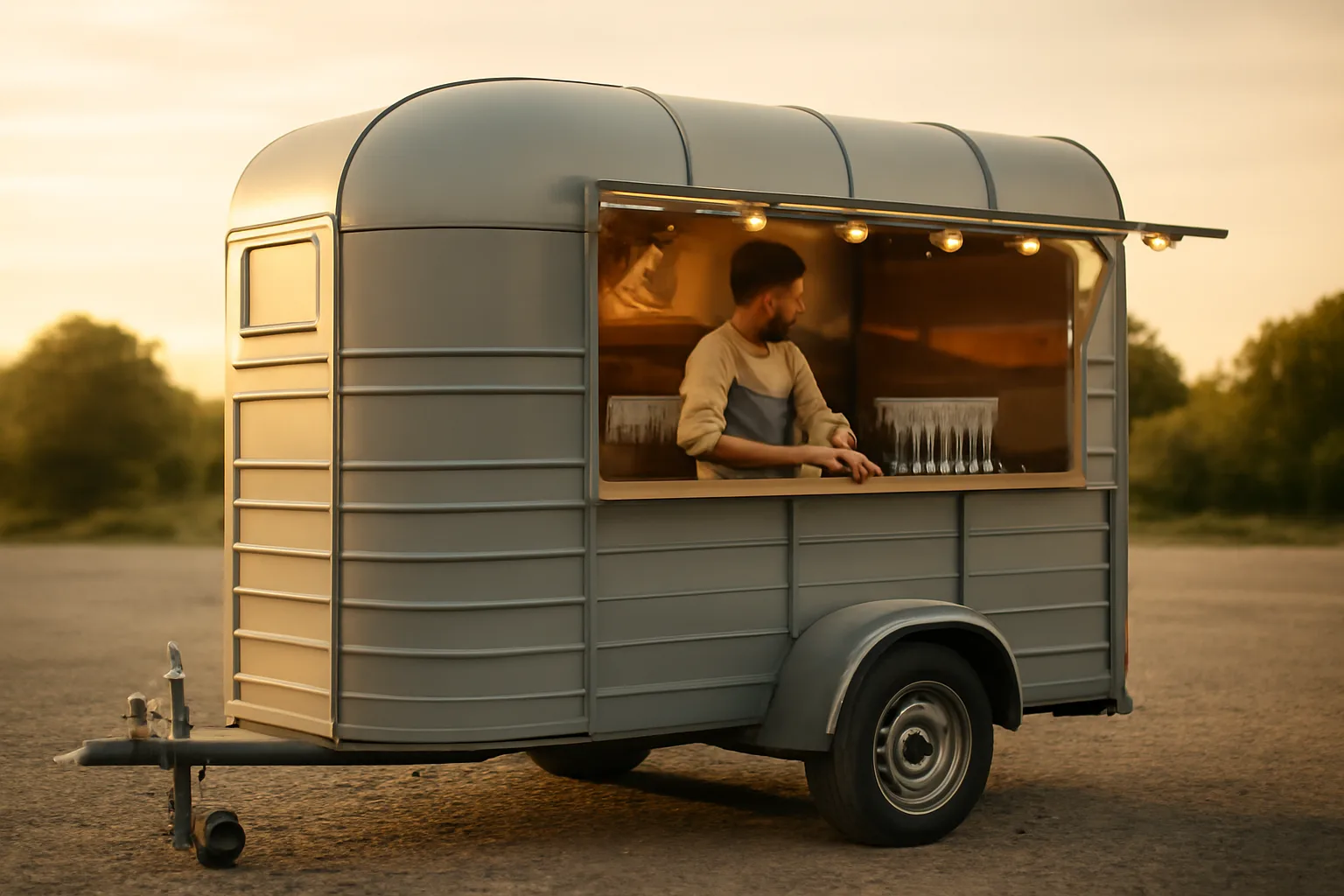
Yes. If a bar on wheels, whether it's a converted horse trailer, a vintage truck, or a rolling cart, is pouring beer, wine, or spirits for anyone other than the owner drinking alone in a garage, it needs some form of state alcohol license. There's no size exemption, no "it's just a hobby" exemption, and no exemption because the bar moves instead of sits in one building. What trips people up is that mobile bars usually don't fit neatly into a standard restaurant or tavern license. Most states handle them through a caterer's permit, a special event permit, or a temporary/one-day license, sometimes stacked together depending on whether you're working private events, public festivals, or both. The Alcohol and Tobacco Tax and Trade Bureau (TTB) handles the federal side under the Federal Alcohol Administration Act, requiring basic permits for producers, importers, and wholesalers, but retail service, which is what a mobile bar does, is regulated entirely at the state and often county or city level [1]. So the honest answer is: yes, you need a license, but which license depends entirely on your state and your business model. A mobile bartending company that only works private weddings under someone else's alcohol purchase looks very different, licensing-wise, from a mobile bar business that buys its own inventory and sells drinks directly to the public at a festival.
What kind of license does a mobile bar actually need?
Most mobile bar operators end up needing one of three things, sometimes more than one at once. A caterer's permit or caterer's authorization is the most common path. It lets a licensed business serve alcohol at locations other than a fixed licensed premises, think weddings, corporate parties, private backyard events. California's Business and Professions Code Section 23399 establishes the Type 58 Caterer's Permit, which authorizes a licensee to sell and serve alcohol at events away from their licensed location, subject to specific event notification requirements [2]. New York's Alcoholic Beverage Control Law Section 100-b similarly allows certain licensees to obtain catering permits for off-site events [2]. A special event permit or temporary permit is the second common route, used when a mobile bar works public, one-off events like festivals, fairs, or fundraisers rather than private catered functions. These are typically issued to organizations or event producers rather than the bar vendor directly, meaning the mobile bar operator may need to be listed as a sub-permittee or work under the event holder's temporary license depending on state rules. A full retail liquor license is the third path, less common for mobile operations but relevant if the mobile bar is the primary business (not a side offering to caterers or event planners) and plans to operate regularly at a fixed set of return locations, or if state law treats mobile vending as requiring the same on-premise retail license as a bar or restaurant. Which category you fall into is a legal classification question, not a marketing one. "We call ourselves a mobile bar" doesn't determine your license type; how alcohol is purchased, who owns it, and where it's served does. That's why the very first call you make shouldn't be to a printer for a menu, it should be to your state ABC authority to ask directly: "What license or permit covers a mobile bar serving alcohol at private events in this state?"
Can you serve alcohol without a liquor license?
No, not legally, and this is the single most common mistake new mobile bar owners make. Serving or selling alcohol without the correct license or permit is a violation of state alcohol beverage control law in every U.S. state, and enforcement isn't rare or theoretical. Penalties typically include fines, seizure of alcohol inventory, and in some states, misdemeanor or felony charges depending on volume and intent. There's a specific trap that catches a lot of mobile bar startups: BYOB or "client-provided alcohol" arrangements. Some operators assume that if the client (say, a wedding couple) buys the alcohol themselves and the mobile bar just "serves" it, no license is needed because no sale is happening. This is state-dependent and often wrong. Many states still require a permit for anyone pouring or dispensing alcohol at an event for compensation, regardless of who purchased the product, because the license covers the act of serving to the public, more than the sale of the product. Texas Alcoholic Beverage Code Section 24.01 governs caterer's permits for parties serving alcohol at events for a fee, and BYOB-style service arrangements still typically require licensing depending on the fee structure [3]. If you're relying on "the venue already has a license" as your legal cover, that's usually not enough either. A venue's on-premise license generally covers alcohol sold and served by that venue's own staff under that specific license, not a third-party mobile bar vendor pouring under a separate business name. You need your own coverage, tied to your own business entity, confirmed with your state ABC authority before your first event.
How much is a liquor license?
There's no single national answer, and anyone who quotes you one flat number without asking what state and license type you mean is guessing. Liquor license costs in the U.S. range from a few hundred dollars for a basic permit application in a low-cost, non-quota state, up into six figures for a full on-premise retail license in a quota-controlled market like parts of California or New York where licenses are capped and traded on a secondary market. For mobile bars specifically, the relevant comparison is usually catering permits and special event permits, which tend to sit at the lower end of that range because they're narrower in scope than a full retail license. But "lower end" still varies by state: application fees, annual renewal fees, and any local (county or city) permit fees stack on top of the state fee, and some states add per-event fees for special event or temporary permits. Because exact fees change and differ by state, county, and sometimes city, the only reliable number is whatever your state ABC authority currently publishes. Don't budget off a number you saw in a blog post or forum thread from three years ago; confirm current fees directly on your state's ABC fee schedule before you build a business plan around it.
How much is a liquor license in Florida?
Florida's liquor license costs depend heavily on license series (which alcohol types you can serve) and, for quota licenses, the county's population-based quota allocation, which can require buying an existing license on the secondary market rather than applying fresh from the state. Florida Statutes Section 565.02 sets out the quota license system and license series structure (like the 2COP for beer and wine only, up through 4COP for full liquor), with fees set annually and varying by county population bracket [4]. For a mobile bar in Florida, a full quota 4COP license usually isn't the right target; the state's caterer's license and special event permits are more relevant, and both have their own fee structures published by the state Division of Alcoholic Beverages and Tobacco. Because Florida's quota license costs on the open market can run from the tens of thousands into six figures depending on county, and the state application fees themselves change annually, don't rely on a fixed number here. Pull the current Florida DBPR license fee page directly [4], and if you're weighing Florida against other states for your mobile bar launch, our state guides hub breaks down license categories state by state. One quick note on adjacent search confusion: people sometimes search "Florida bar" while researching liquor licensing and land on pages about the Florida Bar Association (the attorney licensing body), which has nothing to do with alcohol permits. If you're specifically trying to confirm whether someone is a licensed Florida attorney (for a contract review, say), that's the Florida Bar member search, not the alcohol licensing authority.
How do I get a liquor license for a mobile bar?
The process runs through roughly the same stages in every state, even though the forms and fees differ. Here's the realistic sequence, back-planned from a mobile bar owner who already has events booked. 1. Confirm your license category with the state ABC authority. Call or email and describe your exact business model (private catered events only, public festivals, both, alcohol you purchase versus client-purchased alcohol) and ask which license or permit applies. 2. Form your business entity if you haven't. Most states require the license to be held by a registered business entity (LLC or corporation), not an individual sole proprietor name, though rules vary. 3. Line up your premises and equipment documentation. Even a mobile operation usually needs a home base address for storage and paperwork purposes, plus proof of insurance (liquor liability, sometimes called dram shop coverage, is commonly required and is separate from general liability). 4. Submit the application with required attachments: business formation documents, owner background/fingerprint checks (common in most states), lease or storage documentation, and the fee. 5. Wait for review, which in most states runs anywhere from a few weeks to a few months depending on backlog, background check turnaround, and whether local (county/city) sign-off is also required. 6. Get your license or permit issued, then register for any per-event notification required for special event or catering permits, since many states require you to notify the ABC authority of each event date and location in advance, more than hold the permit passively. That timeline is exactly why back-planning from your opening or first booked event date matters more for mobile bars than for a fixed restaurant. If your state requires 60 to 90 days of processing and you've got a wedding booked in six weeks, you're already behind, and there's no expedited path most states offer for a fee. If you want a structured way to map your specific state's steps against your event calendar, that's exactly the kind of planning problem our $199 State Liquor License Roadmap is built to solve. It's a one-time tool, not a subscription, and it's not legal advice or a guarantee of approval; it's a way to see your state's actual sequence and timing laid out before you're stuck improvising two weeks before a booked event.
How do I get a bartending license?
A "bartending license" almost always means a responsible beverage service (RBS) certification, not a government-issued license to personally own or operate a liquor license. This is a completely different credential from the liquor license the business itself holds. Many states require or strongly encourage anyone serving or selling alcohol, mobile bar staff included, to complete an approved alcohol server training course covering checking IDs, recognizing intoxication, and refusal procedures. Examples include TIPS (Training for Intervention ProcedureS), ServSafe Alcohol, and various state-specific programs. Oregon requires a mandatory Alcohol Service Permit for anyone who serves, sells, or checks ID for alcohol, administered under Oregon Revised Statutes Section 471.402 through the Oregon Liquor and Cannabis Commission [5]. Texas requires TABC seller-server certification for many employees under Texas Administrative Code Title 16, Section 50.3, and it's commonly required by insurers even in situations where an individual employer might not otherwise mandate it [6]. For a mobile bar business, this matters twice over: it's often a legal requirement for your staff, and separately, many liquor liability insurance policies require it or offer lower premiums when all serving staff are certified. Budget for it as a line item, typically a modest per-person course fee plus a few hours of time, and treat it as non-negotiable rather than optional polish.
Can anyone take the bar exam?
This question shows up in liquor license searches because of keyword overlap with "bar," but it has nothing to do with alcohol licensing. The bar exam is the licensing test for practicing law, administered state by state, and eligibility generally requires graduation from an ABA-accredited law school (with limited exceptions in a handful of states) plus passing a character and fitness review [7]. If you landed here from that search: no liquor license or bartending certification requires anything like the bar exam. If you're actually researching attorney licensing, the Florida Bar and California Bar pages cover that state's specific admission rules, and neither has any bearing on your mobile bar's alcohol permit application.
How do I obtain a liquor license as a new business, step by step?
Strip away the state-specific variation and the process is really five decisions in sequence, whether you're opening a fixed restaurant or launching a mobile bar. First, identify your license type. This is almost never optional guesswork; your state ABC authority publishes a license category list, and your business model (on-premise consumption, off-premise sales, catering, special events) determines which one applies. Second, check for quota restrictions. Some license types in some states, particularly full liquor (as opposed to beer/wine only) on-premise licenses, are capped by county population under quota systems. If your category is quota-restricted and the county is full, you may need to buy an existing license on the secondary market rather than apply fresh, which changes your cost and timeline dramatically. Our quota and transfers hub covers how that secondary market works in quota states. Third, gather your documentation: business entity formation, lease or premises documentation, financial disclosures, background checks for owners, and insurance proof. Fourth, submit and track the application, including any required local (county/city) approvals that run parallel to or before the state application, since many states require local sign-off before the state will issue. Fifth, plan your compliance calendar for after approval, renewal dates, per-event notifications if you hold a special event or caterer's permit, and staff training refreshers. Mobile bars follow this exact same sequence; the only real difference is which category in step one applies, since "mobile" isn't itself a license type in most states, it's a business model that maps onto an existing category like catering or special event permits.
How do I get a liquor licence (UK or non-US spelling search)?
If you're specifically asking about the UK or another country, the process is entirely different and this article, which covers U.S. state-by-state alcohol beverage control, won't answer it accurately. In England and Wales, alcohol sales are governed by the Licensing Act 2003, and the relevant credential for a mobile bar or catering operation is typically a Personal Licence plus either a Premises Licence or a Temporary Event Notice (TEN) issued by the local licensing authority, not a state ABC authority. Section 1 of the Licensing Act 2003 defines the licensable activities that trigger this requirement, including the sale of alcohol by retail [8]. For U.S. readers who typed "licence" out of habit or autocomplete: everything above about caterer's permits, special event permits, and state ABC authorities is the correct U.S. framework. The core answer doesn't change: yes, a mobile bar needs a license or permit here too, it's just called something different and issued by a different body.
What documents and insurance does a mobile bar need beyond the license itself?
The liquor license or permit is necessary but rarely sufficient on its own. Most states and most venues (if you're working other people's properties, which mobile bars almost always are) require liquor liability insurance, sometimes called dram shop insurance, separate from your general commercial liability policy. This covers claims arising from alcohol service specifically, like a guest who's over-served and causes an accident afterward. Many venues and event insurers won't let a mobile bar on-site without proof of this coverage, regardless of what your state license technically requires, so treat it as a practical requirement even in states where it's not strictly mandated by statute. Beyond insurance, expect to need: a food handler's permit or health department approval if you're serving any food or ice handling crosses into health code territory, vehicle registration and inspection documentation for the mobile unit itself (this is a separate DMV/transportation matter, not an ABC one), and depending on your state, a bond or letter of credit tied to the license application. None of these substitute for the liquor license itself; they stack on top of it.
What happens if a mobile bar operates without the right license?
Enforcement varies by state, but the range of consequences is consistent in kind: state ABC agencies can issue fines, seize alcohol inventory on-site, and in more serious or repeat cases, refer the matter for misdemeanor or felony prosecution depending on the state's alcohol beverage control statute and the scale of unlicensed activity. Beyond the direct penalty, there's a business consequence that often matters more in practice: getting caught operating without proper licensing can make it much harder to get licensed later, since most applications ask about prior violations, and a documented unlicensed-operation history is exactly the kind of thing that draws extra scrutiny or denial on a future application. There's also the insurance angle. If an incident happens (someone gets over-served, there's an accident) while you're operating without the required license, your liquor liability policy, if you even have one, may not cover the claim at all, since most policies are written contingent on the insured operating under valid, current licensing. That's the scenario that actually bankrupts small mobile bar operators, not the state fine itself.
Frequently asked questions
Do mobile bartending services need a liquor license if the client buys the alcohol?
Often yes. Many states require a license or permit for anyone serving or pouring alcohol for compensation, regardless of who purchased it. This BYOB-style arrangement is a common assumption that turns out to be wrong; confirm directly with your state ABC authority rather than relying on general internet advice, since rules differ significantly by state.
How much is a liquor license?
It ranges from a few hundred dollars for a basic state permit in low-cost states to well over $100,000 for a full on-premise license in quota-controlled markets like parts of California or New York. For mobile bars, catering and special event permits are usually cheaper than full retail licenses. Confirm the current fee on your state ABC authority's published fee schedule.
How much is a liquor license in Florida?
Florida's costs depend on license series (2COP, 4COP, etc.) and, for quota licenses, county population brackets, with secondary-market quota licenses sometimes running into six figures. Mobile bars usually need a caterer's or special event permit instead of a full quota license. Check Florida's Division of Alcoholic Beverages and Tobacco fee schedule for current numbers.
How do I get a bartending license?
There's no government "bartending license" in most states; you need responsible beverage service (RBS) certification like TIPS or ServSafe Alcohol. Oregon and Texas both require this training under their own state statutes for anyone serving alcohol. This is separate from the business's liquor license and is typically required for staff, not owners.
Can you serve alcohol without a liquor license?
No. Serving or selling alcohol without the correct state license or permit violates alcohol beverage control law in every U.S. state and can result in fines, inventory seizure, and criminal charges. A venue's existing license generally doesn't cover a separate mobile bar vendor pouring under its own business name.
Can anyone take the bar exam?
No, this refers to becoming a licensed attorney, unrelated to alcohol licensing. Eligibility generally requires graduating from an ABA-accredited law school (with narrow exceptions in a few states) plus passing a character and fitness review. It has no connection to liquor licenses or bartending certifications despite the shared word "bar".
How do I obtain a liquor license for a new mobile bar business?
Confirm your license category with your state ABC authority (usually a caterer's or special event permit for mobile bars), form your business entity, gather insurance and background check documentation, submit the application, and wait for state and local approval. Timelines run weeks to months; back-plan from your first booked event date.
What license category covers a bar on wheels or bar trailer?
Most states route mobile bars through a caterer's permit (for private events) or a special event/temporary permit (for public festivals), rather than a standalone "mobile bar" category. Which one applies depends on your business model, so confirm directly with your state ABC authority before assuming either fits.
Do I need a separate license for every event my mobile bar works?
It depends on your state and license type. Caterer's permits typically require advance notification of each event location and date rather than a brand-new application each time. Special event or one-day permits, by contrast, are often issued per event. Confirm your state's specific notification and renewal rules.
Does liquor liability insurance replace the need for a liquor license?
No. Insurance and licensing are separate requirements. You need the liquor license or permit to legally serve alcohol, and you typically need liquor liability (dram shop) insurance on top of it, both as a practical requirement for venue access and, in many states, as a condition tied to the license itself.
How long does it take to get a liquor license for a mobile bar?
Timelines vary widely by state, often weeks to several months depending on background checks, local approvals, and application backlog. There's usually no guaranteed expedited path. Because mobile bars often have events booked in advance, apply as early as possible rather than assuming a standard restaurant timeline applies.
Can a mobile bar operate under the license of the venue or event it's working at?
Usually no. A venue's on-premise license generally covers alcohol served by the venue's own staff under that specific license, not a separate mobile bar business pouring under its own name. Most states require the mobile bar operator to hold its own permit or be formally listed as a sub-permittee for the event.
Sources
- Federal Alcohol Administration Act, 27 U.S.C. Section 203: TTB regulates federal alcohol permits for producers, importers, and wholesalers, while retail service is regulated at the state level
- California Business and Professions Code Section 23399, Caterer's Permit: California's Caterer's Permit (Type 58) authorizes licensees to serve alcohol at events away from their licensed premises
- New York Alcoholic Beverage Control Law Section 100-b, Catering Permits: New York allows certain licensees to obtain catering permits or extensions of premises for off-site alcohol service
- Texas Alcoholic Beverage Code Section 24.01, Caterer's Permit: Texas requires a Mixed Beverage Permit or Caterer's Permit for parties serving alcohol at events for a fee
- Florida Statutes Section 565.02, License Fees; Quota Limiting Number of Licenses: Florida issues license series like 2COP and 4COP with fee schedules that vary by county population bracket
- Oregon Revised Statutes Section 471.402, Alcohol Server Education: Oregon requires alcohol server education and a service permit for individuals serving alcohol
- Texas Administrative Code Title 16, Section 50.3, Seller Training Certification: Texas requires TABC seller-server certification commonly required by employers and insurers for alcohol service staff
- American Bar Association, Comprehensive Guide to Bar Admission Requirements: Bar exam eligibility generally requires graduation from an ABA-accredited law school plus a character and fitness review
- Licensing Act 2003, Section 1 (Licensable Activities): In England and Wales, alcohol service requires a Personal Licence plus a Premises Licence or Temporary Event Notice under the Licensing Act 2003